|
A joint publication of: Astro Logos and Zyntara Publications |
|||||||||||||||||||||||||||||||||||||||||||||
|
ISSUE NO. 17 |
|||||||||||||||||||||||||||||||||||||||||||||
|
| |||||||||||||||||||||||||||||||||||||||||||||
|
May 2006 | |||||||||||||||||||||||||||||||||||||||||||||
|
The VAN is a
free monthly electronic newsletter | |||||||||||||||||||||||||||||||||||||||||||||
|
In this issue: |
To
subscribe
or |
||||||||||||||||||||||||||||||||||||||||||||
| Under the Beams or not... - a reconsideration of a traditional technique | |||||||||||||||||||||||||||||||||||||||||||||
|
The Royal Stars of Persia - A focus on Aldebaran |
|||||||||||||||||||||||||||||||||||||||||||||
|
|
|||||||||||||||||||||||||||||||||||||||||||||
|
|
|||||||||||||||||||||||||||||||||||||||||||||
|
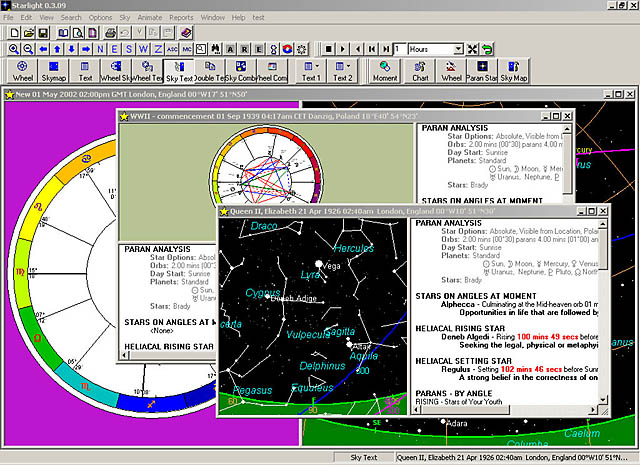
Introduction In this edition of the V.A.N. we are tackling the astrological idea of when a planet is Combust or Under the Sun's Beams. It comes from questions generated from the last newsletter about whether we are going to see the conjunction of Mars and Saturn, and although it is a little bit technical, we have used sky maps to help you "see" the issue. It will also give you some fresh idea about the sky and also about your natal chart. We also continue our exploration of the Royal Stars with a focus on Aldebaran, the great watcher in the East. We look at this star as the heliacal rising star, as well as when linked to your chart through the ancient and visual technique of parans.
|
|||||||||||||||||||||||||||||||||||||||||||||
|
|
|||||||||||||||||||||||||||||||||||||||||||||
|
Under the Beams or not .... a
reconsideration of a traditional teaching One of the traditional teachings within Medieval and also Traditional astrology is that a planet is weakened when it is too close to the Sun. Such a concept is called either Combust (when the planet is within 8 or so degrees of the Sun) or Under the Sun's Beams (within 15 or so degrees of the Sun). Now a planet's relationship to the Sun was also of great importance to the Babylonians and indeed this rather "odd" technique in horoscopic astrology may well have its roots in their visual methods of watching for the appearances and disappearances of the planets. We have many letters to the Assyrian kings from the astrologer-priest devoted to this observation, such as:
This refers to the first appearance of Jupiter from under the Sun's beams in the month of Tammuz. Another such letter reads:
This notes that the planet Venus has disappeared (under the rising Sun's rays) in the month of Nisan and that this is a difficult omen. The Rhythm of Sun and Planets The planets [Venus, Mercury, Mars, Jupiter and Saturn] are visible in the night sky for most of the year but each planet will go through a period when it disappears from view. Such behaviour as noted above was closely watched by the Babylonian priest. However, as astrologers moved away from the sky and focused on the horoscope alone, this observance of disappearance and reappearance seems to have morphed into the doctrines of “combust” or “under the beams”. A planet is considered to be weakened or damaged by its close proximity to the sun but the ill-defined damaged may be better understood if one understands that the planet is no longer visible, is travelling through the underworld, like Nergal (Mars) as discussed in the April newsletter. However, Medieval and Traditional astrology simply judged these conditions by the number of degrees between the planet and the Sun in a horoscope. But this is an over simplification which I believe distorts the actual key concept being examined. The visibility of a planet (ignoring the local weather) depends on three factors: firstly, the distance between the Sun and the planet; secondly, the latitude of the observer; and, thirdly, the time of the year when the planet disappears. By ignoring the sky and just looking at the two dimensional horoscope, horoscopic astrology has become blind to the latter two vital conditions. Let us consider the chart for Ada Byron, Lady Lovelace (1815 – 1852). She was the daughter of the English poet Lord Byron but she found her poetry in mathematics and not only is accredited with conceiving the idea of the first computers but she is considered to have written the first software program. She was born 10 December, 1815, at 1.00 pm in London, UK. One of the features of her chart is her Venus-Jupiter conjunction and indeed if look at the chart for dawn on the day she was born (shown as insert), you will see that the Sun in the 1st house is 150 ecliptical degrees below the Ascendant and that the Venus-Jupiter conjunction in the 11th house is 300 ecliptical degrees above the Ascendant. In her chart therefore this Venus-Jupiter combination is quite strong and emphasised because it is so bright in the sky just before dawn - Ptolemy would point this out as being part of her strong solar doryphory, a particularly important medieval astrological technique but one that seems to be lost in later version of astrology. Now the sky map above (and the chart) are set for dawn on that day. Daylight will begin to fill the sky for any location whenever the Sun moves to within 120 below the horizon. Importantly this is not 120 on the ecliptic but rather 120 in altitude (in this case depression), degrees measured above or below the actual line of the horizon. This is considered nautical twilight. If you look at the sky map above, the grid lines on the map are set for every 50, thus you can see the Sun is 100 below the horizon and the Venus-Jupiter conjunction is about 230 above the horizon. Thus this map is set for the time period where there was the half light of dawn on that December morning, but we can also see that the brilliant Venus-Jupiter conjunction would still be clearly visible but beginning to be lost in the Sun's light. By contrast, if we keep the same location (London) but move the time of the year to the month of May, we see a very different situation.
In the sky map (above) set for 10 May, 2006, in London, we can see that on this day Venus (similar to Lady Lovelace) is 420 ecliptical degrees ahead of the sun and rising before the Sun. But is this Venus visible? The sky map is set for the Sun being 100 below the line of the horizon (two grid lines down from the line of the horizon, just as in the case of the Lady Lovelace map), so once again this map is set for dawn. However, if you look at the chart for that moment (insert), you will notice that the Sun is at 190 Taurus and the Ascendant at 90 Aries. The Sun is 390 below the horizon, yet it is still the beginning of dawn. Furthermore the planet
Venus, although well separated from the Sun, will not be seen to rise
before dawn. Indeed at the time of dawn, Venus in the sky map is still
below the horizon. This huge difference is caused by the angle that the
ecliptic (the white line) forms to the horizon at the latitude of London.
In this chart therefore Venus is really still "Under the Sun’s Beams",
even through Venus is 420 away from the Sun!
If we moved the location of this same chart to the southern hemisphere, let us say Cape Town, South Africa (latitude of 33/55 South), then the angle of the ecliptic and the horizon is hugely different. Venus is now clearly visible well before dawn, being about 300 of elevation above the horizon at the time (see sky map right). Latitude and the time of the year makes a huge difference to the visibility of a planet. So in returning to the astrological concepts of Combust and Under the Beams, if they are fragments of visual astrology (and indeed their very terms implies a visual element), then the application of orbs on the ecliptic which ignore the seasons and the latitude and thus the actual visual appearance, may be a gross over- simplification of a beautiful and meaningful visual technique. Furthermore, in today’s astrological world of computer software, it is so easy to reconstruct the actual sky for any given horoscope and with such tools it may well be time for a re-evaluation of the implications of having a planet in a natal chart combust. It could prove most illuminating when one actually examines charts of whether the planet is actually consumed by the rays of the sun, rather than judging this condition in a chart based on an average situation for the seasons and latitude of Egypt – Ptolemy’s location. In Your Own Chart Have a look at the planets that rise before your sun on the day of your birth. If you own Starlight, have a look at your own natal sky map. Turn on the azimuth grid (the little "A" button in the sky map tool bar which will default to 15 degree slots), then animate the chart to move the Sun so that it is sitting 10 degrees below the horizon. Now look to see what planets are rising. If you do have planet's rising above the horizon line, those planets will be most important in your life and even give you a clue as to your profession and preferred lifestyle. If you do not own Starlight, then see if you can use any other planetarium software, just so you can get a look at the sky for the dawn of the day of your birth. I think you will find it most illuminating!
|
|||||||||||||||||||||||||||||||||||||||||||||
|
[1] Hunger, Herman. (1992). Astrological Reports to Assyrian Kings. Helsinki, Finland: Helsinki University Press. pg.50.
[2] id bid pg 254.
The Royal Stars of Persia - A focus on Aldebaran
The Royal Stars of Persia. The name alone evokes exotic perfumes, spices
of the sun, flames of gold,
and
silk and wool carpets whose sequences of knots
tell stories of trees and flowers, birds and clouds. Thus to have your chart connected in some way with a Royal Star means that there will always be this duality between light and destruction interwoven into your earthly journey. Great glory is promised to you but only if you can overcome the nemesis which can destroy. In recent issues we considered Antares and Regulus. In this issue of the VAN I am focusing on Aldebaran, the Watcher of the East. Aldebaran as the natal Heliacal Rising Star Aldebaran is a bright red star in the sky in the southern eye of the constellation Taurus, The Bull, the great cornerstone marking the spring equinox. Aldebaran was seen as the god Mithra, or Ahura Mazda, the slayer of the Cosmic Bull, a great military god who gave victories to his followers but only if they followed the strictest procedure in his worship. As well, Mithra was a warrior king who also held the title 'lord of contracts'. He considered all exchanges were sacred and in overseeing the business of his followers, insisted on their honesty and purity or else they would be condemned to an ordeal of fire. From these ancient beliefs and customs we can extrapolate a more current and present-day meaning regarding success, for Aldebaran, in keeping with all the Royal Stars, promises the attainment of one's goals but only, in this case, by maintaining moral integrity. Any compromise on this level and all that has been achieved can be rapidly lost, and possibly in some way involving fire.(1) I used Starlight to scan my files for charts that contained Aldebaran as the heliacal rising star (see August, 2005 issue of this newsletter for more information concerning the heliacal rising star) and found the following examples:
The heliacal rising star is the star that has been walking the path of the underworld and has now emerged to be visible in the world of humans bearing gifts from the land of the person’s past, their family or their genetics. This gift or treasure is handed to the person at birth. The heliacal rising star is a theme in the person’s life. It helps build the person’s philosophies and can, at times, take on a vocational pulse. To have Aldebaran as one’s heliacal rising star indicates that you are born with strong principals and ethics and feel deeply and intensely about certain issues in life and how they can be achieved. You will be challenged to maintain your principals in the face of compromise, and as long as you can maintain your focus, success is yours. We get a glimpse of how these principals have been articulated in the examples of the people above.
Aldebaran
in paran with a planet
I also used Starlight to
search for people who had
Aldebaran
in paran
with a
planet or luminary
found the following people:
If
you have
Aldebaran
rising
with one of your planets or culminating or setting, or even reaching the
nadir of your chart while one of your natal planets was also on an angle, then
it
can give you glory, the glory metaphorically symbolized by
exotic perfumes, spices of the sun, flames of gold,
and
knotted silk carpets. However, your challenge will be to maintain your integrity in
the face of compromise.
You can visit
Starlight's web site to request to be
sent your fixed stars and planetary visual astrology parans - this is a
free service we offer all those astrologers who wish to engage the sky
with their chart. [1] Brady, Bernadette. (1999). Brady’s Book of Fixed Stars, Samuel Weiser Inc: York Beach, Maine. Note: All the meanings of star and planet parans quoted are taken from Starlight Software. © Barnswood Ltd and Bernadette Brady.
| |||||||||||||||||||||||||||||||||||||||||||||
|
|
If you are busy but want to learn good astrology, then Studyshops give you a front row seat in full-day workshops from some of the world's top astrologers but in the comfort of your own home and in your own time. Studyshops are actually better than being in the original workshop because they contain so much more material on the subject. That is why thousands have been sold, from the far reaches of China across Europe and the Americas! You can browse the full catalogue, as well as buy on-line, by clicking here. Each studyshop is £25.95 (about $44 US). As well, whenever we launch a new title, we always let everyone on our list know so you get a chance to buy these at the special launch price.
Do something for yourself and your astrology and check them out when you have a few minutes to spend on the web. We think you will find it worth your while: Studyshop On the Web Link Special notice about receiving this newsletter: With new filtering systems monitoring emails, many of the people who wish to receive this newsletter are being blocked by internet email filters. Thus in order to ensure that you are able to continue to receive this newsletter, please add our email to your address book: newsletter@Zyntara.com Thank you.
|
||||||||||||||||||||||||||||||||||||||||||||