|
A joint publication of: Astro Logos and Zyntara Publications |
|||||
|
ISSUE NO. 24 |
|||||
|
| |||||
|
December 2006 | |||||
|
| |||||
|
In this issue: |
To subscribe or
|
||||
| The Founder of the Contemporary Environmental Movement named - a look at Jupiter | |||||
| Special Notices at the end of this newsletter:
A Master's Degree in Archaeoastronomy at Lampeter University in Wales, UK Ptolemy's Almagest - free software for working with the stars of the Almagest | |||||
|
VAN Archive - www.Zyntara.com |
|||||
|
|
|||||
Last month
many readers emailed us with thoughts on our article on The King stands
Alone (November, 2006) linking it with the results of the US
elections which left President George Bush isolated in the White House. We
agree it would seem a very good and interesting expression of the isolated
Saturn. Both Darrelyn and myself are constantly in awe of the potency of
these sky narratives.
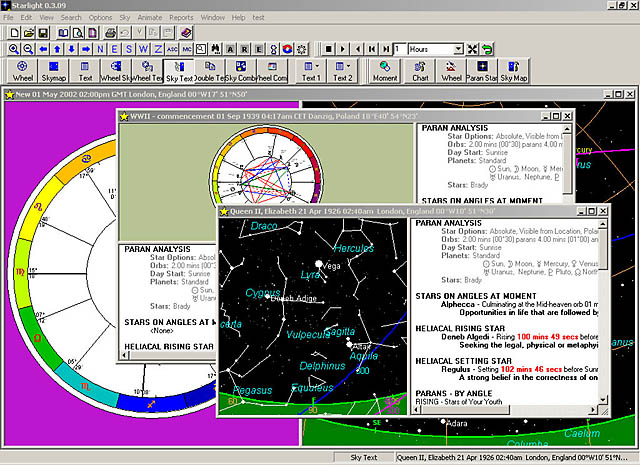
Through our sheer love of this subject, we have produced a limited number of Visual Astrology Newsletter 2007 Desk Calendars. Each month shows the view of the new crescent moon with the constellations. The reverse side of every month gives information about that part of the sky. The calendar is available free of charge to anyone ordering two or more Studyshops from Astro Logos or can be bought separately for £7.95. They are great stocking fillers for Christmas and we do expect to sell out of our small remaining stock of 200 calendars. We love these calendars and if you are enjoying the Visual Astrology Newsletter, we think you will as well. |
|||||
|
Sulpa'e, the return of the crown
prince One of the key differences between horoscopic astrology and visual astrology is that when we are looking at the sky, we notice that planets will disappear from view and then reappear as they change their relationship to the sun. Thus if you are looking at a horoscope for mid-December, 2006, you will notice a Jupiter/Mars conjunction in Sagittarius but if you have actually been watching the sky, you will notice something far more important unfolding. Jupiter has been lost from view, and indeed as discussed in last month’s newsletter, the king (Saturn) has been standing alone in the sky. But in mid- December Jupiter will reappear in the early morning light and be seen rising amongst the stars of the Scorpion.
Left: The sky at dawn on 16 December, 2006, at a latitude of 40 N. Jupiter will be seen rising in the early dawn light as a faint but bright light in the sky. If you are lucky you may even see the red star Antares, the heart of the Scorpion. To the Babylonians, such a Jupiter (return to visibility) was named Sulpa'e.
To the Babylonians, the return of Jupiter was a time of rejoicing and the new born god (planet) was named Sulpa'e to distinguish it from when Jupiter was rising at any other time of the night when it was called Sagmegar. Jupiter’s other name when it reached culmination was Neheru:
This passage refers to the time when the stars in the northern sky have faded in the dawn light but the great star Jupiter can still be seen shining faintly while standing in the middle of the sky, on the meridian or the MC (van der Waerden, 1949). We will explore Jupiter as Neheru in later newsletters as this is something that horoscopic astrology totally ignores. For now we are going to explore Jupiter as Sulpa’e.
But this Sulpa’e who comes to us in December, 2006, is different. As we have explored in other newsletters, Jupiter is symbolic of a powerful crown prince or military general who steps onto the world stage. Now all this year Jupiter has been supportive of the king's activities but now, in his new guise as Sulpa’e, he rises with Nergal (Mars) and they both re-appear amongst the stars of the great Scorpion. Mars and Jupiter together are seen as a difficult conjunction, as Nabu-iqusa, a sixth century Babylonian astrology/priest, points out :
Above: image of
a astrologer
So in reading the sky narrative, in mid-December we will have Sulpa’e stepping onto the world stage (Jupiter becomes visible in the pre-dawn light) with anger in his heart and war on his mind (with Mars in the stars of the Scorpion), at the time when the king (Saturn) stands alone (which many readers have suggested is reflected in President Bush’s isolation due to the loss of both houses of parliament in the US elections last month). Jupiter as Sulpa’e amongst the stars of Scorpio will occur, of course, every twelve years, but the addition of Mars makes this event far less frequent. Indeed in searching back using both Jigsaw and Starlight over the last thousand years, I have found only three other such times. Sulpa'e in
1342 Sulpa'e in
1579 Sulpa'e in
1769 By late 1769 tension was rising in the new British colony of New York. Bowing to pressure from Britain, the New York Assembly had voted to provide £2000 to provide food and shelter to British troops stationed there. The people were infuriated, believing the Assembly had betrayed the inhabitants of the new colony. Indeed this £2000 acted as a catalysis and by January, 1770, violence had broken out between the British soldiers garrisoned in New York and the local patriots. This is considered by many to be the first steps, or beginning, of the American War of Independence some five years later. Sulpa'e in 2006 Ending Note: Such a Sulpa'e does not seem good for achieving great things in one's life. I scanned over 3,000 charts of famous people to see who was born with a Sulpa'e amongst the stars of the Scorpion and found not a single famous chart. Look in your own files for a Jupiter in early degrees of Sagittarius while the Sun is in late degrees of Sagittarius and see what you find. It would seem that such a Sulpa'e in a natal chart is not about achievement on the world stage but it may be achievement on a more anonymous level. After all, we do not know the names of the first patriots in New York to say enough is enough to the British but we have certainly seen and felt the results of their actions!
The Founder
of the Contemporary Environmental Darrelyn Gunzburg
Carson’s background
in biology and zoology and her love of writing found a happy marriage when
she obtained a job writing radio scripts for the US Fisheries and Wildlife
Service during the Depression. She wrote her first book, The Sea Around
Us, in 1941, describing the struggle for life in the ocean, and whilst
a critical success, it did not sell well. Two more books followed where
she showed her rare skill of being able to write about complicated
scientific information in moving, lyrical prose. The eventual success of
The Sea Around Us finally enabled her to resign from government
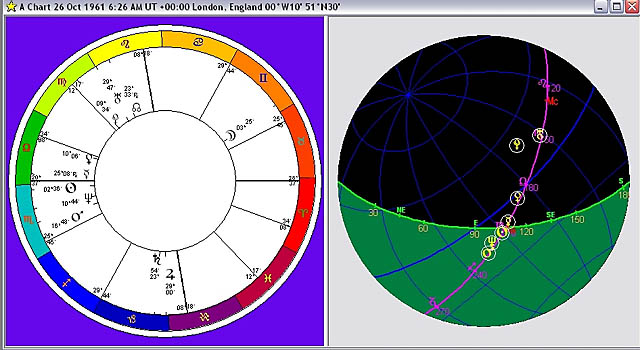
service in 1952 and devote herself to her writing. Carson has Jupiter in Cancer (exalted) in opposition to Mars in Capricorn (exalted). One can suggest that this opposition is the engine room of her chart providing conflict, drive and determination particularly when we see that she also has Neptune and Uranus involved in the pattern. However, the Jupiter-Mars is the more personal side of this opposition, so let's look at what stars are in paran to this key part of her chart.
Starlight says of
Jupiter in paran with with the royal star Fomalhaut (see the November Newsletter): And in paran with
her Mars was Pollux in Gemini which is defined in Starlight
as: Carson’s desire to express a philosophical cause through her writing was indeed to prove both unpopular and a dangerous opinion. For big businesses who had interests in chemicals, reacted strongly to her suggestion in Silent Spring that the totally eradication of all insect life would result not only in the loss of bird life (hence the title of the book) but the breakdown of the entire environment. She was slandered and her scientific credentials were undermined and many other scientists dismissed her as an amateur, a hysterical spinster and a sensationalist. Yet the book fired and inspired the public and within months, government policy was changing. Because of Carson’s profound effect on all of us, I also had a look at her Jupiter through Starlight’s mundane parans which is a way of looking at a person’s relationship to larger global issues. (For those of you who own Starlight, simple select “Mundane Parans” under the Text 1 or Text 2 button). Rachel Carson’s Jupiter gave the following mundane parans: Jupiter
rising when
Betelgeuse is rising: Being confident
in actions These need no additional comment but what I did notice, also under her mundane parans, was a star in paran relationship to her Pluto - Ras Alhague, the head of Ophiuchus and the great healer in the sky. Brady says of this combination in Starlight: “The wisdom of one influences many”. Indeed we have all benefited from the wisdom of Rachel Carson. The results of the public’s response to Silent Spring was that Rachel Carson was invited to speak before a Senate scientific committee, and in 1972 the Government publicly accepted the risks that DDT posed to the environment and human health and its use was stopped. Here we see the
results of Carson being confident in her actions (Jupiter in paran with
Betelgeuse), Unfortunately Carson did not live to see the results of the change of government policy for she died from breast cancer 14 April, 1964, just two years after the book was published. Nevertheless her vision lives on and many are aware that it is as relevant today as it was when she wrote it. Notices: New MA Course in Archaeoastronomy and Landscape Archaeology If you love visual astrology, perhaps you
would also enjoy learning to look at the sky through the eyes of
prehistoric people. This is what the subject of archaeoastronomy is about
- working out how ancient sites such as stone circles were orientated or
aligned to the sun, moon and stars.
![]() The first MA in this subject at a British
university will start in March 2007 at Lampeter University in Wales (image right). It will be a part-time course run over
three years. Students will attend once a term in the first two years for
either a long weekend or a week, completing assignments afterwards from
home. The dissertation for the MA will then be written in the third year.
The course will be run by the Archaeology department, with Robin Heath
taking charge of the archaeoastronomy.
Applications are welcome from students
with either an arts or a science background. This is an opportunity to
take part in a pioneering new course with an emphasis on practical field
study. Further details and dates are on the Lampeter University
website
-
www.lamp.ac.uk/archanth/postgrad/archaeoastronomy_landscape_archaeology.html _____________________________ Ernie Wright as written a free downloadable Windows program, Almagest Stars, that
plots the stars of We have not yet explored the above
program but you may enjoy looking at the sky through Ptolemy's eyes.
However for Starlight users, you can switch on Ptolemy's star
descriptions for the Sky Maps by going to "Sky Map options" and under Star
Labels select "Ptolemy Descriptions". Receiving this newsletter: Some readers complain that they do not
receive the newsletter but with new filtering systems monitoring emails,
some of the people who wish to receive this newsletter are being blocked
by internet email filters. Thus in order to ensure that you are able to
continue to receive this newsletter, please add our email to your address
book: newsletter@Zyntara.com
Thank you. |
|||||
|
|
|
||||