|
|
|
A Shuffling of Crowns –
A Blood Moon over Europe
Bernadette Brady
M.A.
Cast yourself back
four thousand years or so into Mesopotamia and place yourself
outside looking out over the clear night sky watching a glorious
full moon. This full moon is special because it is occurring not
only with the planet Saturn (symbolic of the king) but
that Saturn
has moved near the king’s star – Regulus. Here is the moon god Sin,
clearly bestowing power and blessings on the king and his realm.
But as you watch
this full moon, the predictions and warnings of the priest comes to
pass, for the moon god Sin turns to blood in front of your eyes. Your only thought is
to hope that the king has
performed the rituals
prescribed by the priest in order to avoid the disaster indicated by
such a powerful omen. Surely, you ponder,
the substitute king will die in the face of such a strong visual
omen.
|
 |
|
The full
moon turns to blood as it moves through the stars of the King
(Regulus and Saturn) |
There
has been much
astrological “water under the bridge” since those early stirrings of
astrology but the sky does not change, only our attitude to it.
Is this omen,
given to us on the evening 3 March, 2007, still important?
Can we turn our modern eyes away from such a powerful visual
experience of a blood moon with Regulus
and Saturn all standing together in a
straight line in the evening sky over Europe?
The questions that
flood our modern astrological minds are no longer
about rituals and substitute kings but rather we ask ourselves how often does
this happen and what has it heralded, if anything
in the past?
I used Jigsaw to scan through the last 1,000 years of
ephemeris and found that this visual
phenomenon occurs every second century. In one
century there will be a total, or nearly total
lunar eclipse in the constellation Leo when
Saturn is also present.
This phenomenon will occur in the early
months of the year for possibly a few consecutive years.
After this it may be seen
once again when Saturn
is
amongst the stars of Leo (29 or roughly 58 years later),
however this will be
later in the
century. After that the phenomenon disappears for a
century, to return again in
the following century.
Thus in the last 1,000 years we have had this event in the 11th
century, 13th century, 15th century, 17th
century, 19th century and now we are beginning the
“cycle” again in the 21st century.
The
Pattern - A lunar eclipse near Regulus
while Saturn is around the stars of Leo
and the eclipse visible over Europe.
The 11th Century
Eclipse on 3 March
1067–
The death of the Byzantine Emperor – Constantine X on 22 May.
The 13th Century
Eclipse on
23 January 1274
-
King
Edward I of England finally returns from the Ninth Crusade to
England to be crowned king, two years after his father King Henry
III's death.
The 15th Century -
Regicide
On the night of
the 18 January 1478 in Europe the full moon rose with “unwashed
feet” (eclipse already commenced see
September, 2006 and
October, 2005 for more information) followed by Saturn and then
Regulus. By April of that year a reigning monarch had been
assassinated while at Mass in a cathedral. This was a double
outrage, firstly the killing of a king and secondly the
violation of the sacred space of a cathedral. The king was Giuliano de Medici, monarch of Florence and there were large
repercussion in Florence over this murder with the perpetrators
being savagely punished.
(Right Giuliano de
Medici painted from his death mask) |
 |
The 17th Century - An
ill-fated King takes the English throne and European revolts
22 March 1625 - The next occurrence of this visual phenomenon over
Europe
heralded the death of James I of
England
(died 27 March)
and the ill-fated Charles I (later executed)
takes the throne.
14 March of 1653 and 3 March of 1654
– Post-English civil war period. Charles I who took the throne in March
1625, had been executed in 1549. Oliver Cromwell was made Lord
Protector on 16 December, 1653.
21 February 1682–
The Czar of Russia (Fyodor III) died in April/ May without issue
which lead to a bloody revolt, “the Moscow Uprising”, which eventually
placed Sophia on the Russian throne ruling on behalf of her sons,
Ivan and Peter (later
known as Peter the Great).
19th
Century - another French Revolution but a new Kingdom is formed
9 March, 1830
– The moon rose with “unwashed feet” over Europe with
Saturn and Regulus. – This year saw the
French
Revolution of 1830, also known as the “July Revolution”, where
Charles X of France was removed from the throne.
26 February 1831 – Once again the moon rose with “unwashed feet” over
Europe with
Saturn and Regulus. In this year there was the creation of a
new kingdom. The first “King
of the Belgians" Leopold I, took the Belgium throne on the 26
June 1831. This confirmed the nobility of the Saxe-Coburg line
and it was Leopold I who arranged for his niece (later known as
Queen Victoria) to marry his nephew Prince Albert of Saxe-Coburg
and Gotha.
(Right:
Queen Victoria and Albert, painted by Landseer at Bal
Costumé of 12 May 1842)
29 January 1888
- Two Emperors of Germany die in the one year - William I died
on March 9 and his son (Frederick III) ruled for only 99 days,
succeeded by William II, who was the last Emperor of Germany and
Prussia and who took Germany into WWI. |
 |
21st Century
3 March, 2007
– There are eleven crowns in Europe; Britain, Denmark, Sweden,
Spain, Netherlands, Liechtenstein, Norway, Belgium, Luxembourg,
Morocco and let us not forget the Pope in Rome – who also holds a
crown. Will there be another episode in the Saxe-Coburg line, the
British royal family, or will another crown of Europe change hands?
 |
Born under an eclipse:
The Man Who Would be King
A
Case Study -
Darrelyn Gunzburg
Prince William
(21 June 1982, 21:03
London, England), the young man whose shy sideways glance seals forever
the immortality of his mother, Diana, Princess of Wales, in his face, was
born on an eclipse (Sun and Moon conjunct the North Node) – (Saros Series
2 Old North or van den Bergh 117)
When
someone is born on an eclipse, the essence of that eclipse is contained as
part of the person’s fate or pathway. Brady [1] describes Saros Series 2
Old North as being “a difficult eclipse family” in terms of friendships or
relationships where the person has to face the results of separation or
endings in some way. This Saros Series, however, also contains a note of
optimism, for if the situation is handled with timely action, such action
can turn disaster into triumph and that:
…lives touched by this
Series often symbolize schism rift or disunion. Life’s challenges will
highlight the ability to act quickly, allowing old structures to crumble
while learning how to create new forms from the collapse of the old
ones.[2]
 |
William’s history is not new to us. He was born as the obligatory
first son, heir to the heir of the throne, when Diana’s and Charles’
relationship was already under siege. The changes made since Diana’s
death to the Royals’ personal relationships – Charles’ marriage to
Camilla, and William’s and Harry’s intimate relationships with
“commoners” - are the legacy of her demise. Yet William embodied this
Saros Series in an action so far removed from that of his mother and
father when he and his current girlfriend, Kate Middleton, lived
together as students whilst studying at St. Andrews University until
their graduation in 2005. Although he says he does not wish to marry
before the age of twenty-eight, if William marries Kate Middleton, it
will be the first time in history that a future king has married a
commoner who is not an aristocrat. |
Perhaps
one meaning for William being born on this eclipse is the “separation
and ending” of the tradition of a monarch marrying (or being) a virgin
and of royal blood.
Another meaning is that William may, in some way, change the role of
the monarchy, a view long held by astrologers. The Saros Series
commenced in 792, almost the time of the beginning of the Royal
Monarchy, and completes in July 2036 when William will be fifty-four
years old. David Starkey [3] writes that the English monarchy, now
over fifteen hundred years old. |

|
“… is the oldest
functioning political institution in Europe. It is also unique because,
right from the beginning, the English monarchy had a strong popular
element. This means that its history is more than a tale of kings and
queens, or royal heroes like King Alfred and Henry V and crowned villains
like King John. It's also the story of a dialogue between king and people
in which the English people learned to rule themselves…”
Brady’s[4] suggested writing in 1992 that:
“…for Prince William, a future King of England, to be part of this
Series is to presuppose that he may well be the last British Monarch in
the current style… He would then find himself face with the choice of
either adapting very quickly or being swept away with the old
structure.”
We can
gain further insight into this eclipse and the role it plays in William’s
life by considering the fixed stars that sit underneath this Sun and Moon.
These are
Deneb Algedi
with the Sun and the Moon and
Facies
with the Moon, all of which come into play in William’s life in his
culminating years, the years of his prime, we could say those years after
his Saturn return and when he is most likely to sit upon the throne.
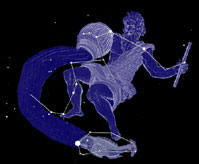
Deneb Algedi
sits in the
tail of Capricorn, the sea-goat, carrying the concept of the law-giving,
justice orientated, civilizing saviour, the benefic ruler using wisdom and
knowledge to protect and help his people (see
February, 2005
issue of this newsletter) William’s Sun is in the 7th house, so he needs
to be in relationship (either intimate and/or, as future heir to the
throne, with the people of Britain). He learns this from both his
parents (Sun-Moon in the 7th house) and with his Sun being in opposition
to Neptune across the Ascendant-Descendant axis
[5], this relationship in its best expression is one of
gentleness, connected with the arts, religion, the sea, travel or
metaphysics and defined by clear boundaries and high
principals.
William’s University degree was in art history (Sun-Neptune), an early
expression of this aspect. We can add to our understanding of what type of
ruler he will be by considering his luminaries both in paran with Deneb
Algedi, as defined in Starlight:
Deneb Algedi as the Sun is Rising -
To be respected, to give wisdom
Deneb Algedi as
the Moon is Rising
A
story-teller, the use of story to promote greater awareness of humanity
We could say that on the
throne William brings a gentle, yin approach (Sun-Moon in Cancer, Sun
opposition Neptune) to his role as monarch, always being confronted with
issues of integrity (Sun-Neptune) in order to protect and help his people
(in paran with Deneb Algedi) and thus gaining respect (Sun in paran with
Deneb Algedi). In some way he also utilises his training in art history
“the use of story to promote greater awareness of humanity” (Moon in paran with Deneb
Algedi). When we connect this with William being born under an eclipse, it
would appear from his fixed stars that he is able to change the monarch’s
role in a way that is respected by the people.
Yet William also has Facies
in paran with his Moon. Once again from Starlight we have
Facies
as the Moon is On Nadir
Emotionally experiencing violence or turmoil
I
considered Facies in depth in the
February 2007
issue of the Visual Astrology Newsletter: when Facies makes a paran to
a planet or luminary in a person’s chart, if it is the only difficult
star, the planet it touches will be extremely focused and driven. In
William’s chart, given that he is the one who changes the monarch’s role
in society, such a fixed star sitting underneath his Moon makes sense,
particularly when linked with Deneb Algedi in the same time period. Here
is someone who is respected (Moon in paran with Deneb Algedi) for their
ability to publicly change, yet who experiences emotional turmoil (Moon in
paran with Facies) in so doing.
Time
will tell as events unfold just how this will manifest for Prince William
and the English Royal family but we can see from the above how the
marriage of understanding what it means to be born on an eclipse along
with the meanings of the fixed star in paran with the person’s Sun and
Moon gives a depth and poignancy to a person’s pathway.
Eclipse Season Special
25% discount on the
Eclipse
Studyshop
-normally £25.95 but just for this month
£19.45
Receiving this
newsletter:
Some readers complain that they do not
receive the newsletter but with new filtering systems monitoring emails,
some of the people who wish to receive this newsletter are being blocked
by internet email filters. Thus in order to ensure that you are able to
continue to receive this newsletter, please add our email to your address
book: newsletter@Zyntara.com
Thank you. |
|