|
A joint publication of: Astro Logos and Zyntara Publications |
||||
|
ISSUE NO. 15 |
||||
|
| ||||
|
March 2006 | ||||
|
The VAN is a
free monthly electronic newsletter | ||||
|
In this issue: |
To
subscribe
or |
|||
| To Draw Down the Moon - When the Moon reaches out | ||||
| Isadora Duncan – Born with a Witches' Moon | ||||
| Additional Notes: Standstill dates and information/ Do Comets have a voice in Visual Astrology? | ||||
|
VAN Archive - www.Zyntara.com |
||||
|
|
||||
|
Introduction This is a busy newsletter this month. The main theme of this edition of the V.A.N. is the moon, for this is the year of the southern standstill. This is an event where the moon seems to wander far from its normal path and was once believed to be important to sky-gazers and ancient astrologers alike. In this issue we explore this theme through the pagan practise of classical Greece and their neo-pagan reflections in current times. We also consider the astrological implications of being born when the moon is being "drawn down". Additionally a new comet has appeared
amongst the stars of Capricorn and Sagittarius, so as visual astrologers,
we have suggested its possible meaning but with the attitude of "wait and
see". |
||||
|
|
||||
|
In a lunar
calendar, the Moon’s phase will always be at the same day of the calendar
month with the new moon always occurring on the 1st of the month, the
full moon on the 14th, and so on. Additionally, the elevation of the
moon's arc
across the evening sky as it travels from east to west
will be the same for any specific month. Thus if we lived by a lunar
calendar and March was the name of one of the lunar months then I would expect that 7th March every year would have a first
quarter moon - seven days after the new moon - and that this moon
would rise to an elevation during the night which would be different from
all the other months but the same for every March from one year to
the next.
So the lunar calendar drifts against the seasons but is
tightly focused on the visual appearance of the moon. The Jewish and
Islamic faiths still work with a lunar calendar. Therefore the lowest full moon of the year will be at the time of the summer solstice and the highest full moon of the year will be at the time of the winter solstice. This is a pattern, a dance the moon produces that the lunar calendar not only acknowledges but also brings into sharp focus for us. This focus was important to the Assyrian astrologer/priest of 650 B.C.E. who noted that, when the moon god Sin was traveling through the stars of Capricorn, he would always be low in the sky. However, when Sin traveled through the stars of Cancer, he could gain great elevation, climbing to his highest position in the night sky. (It is tempting to see this as being linked to the astrological idea of rulership and detriment of the moon but that idea needs to wait for another newsletter).
Yet the position of the moon in the sky has another rhythm
which mingles with its normal seasonal rhythm. There is a 18/19-year cycle
where the moon will be seen to be even lower in the sky, closer to the
horizon or far higher than its normal position. We do not pay any
attention to this in our modern astrology but the Assyrians
recorded the moon's movement every month, including such odd positions in a
particular month as these. Sometimes this was considered fortunate; at other times it was a sign of “wolves and lions ravishing the land.”
The island in question is a somewhere near Greenland or the upper parts of Scotland which many believe to be the circle of stones at Callanish, UK, and which appear to have strong visual links to this particular lunar cycle (Callanish shown image right). Others consider that Diodorus was been referring to Stonehenge (upper image). By this comment, Diodorus of Sicily is suggesting that the tendency of the risen moon to stay close to the earth is a sign of the gods touching the earth or visiting the earth. The Roman poet Horace (Epode 17) also implies this when he quotes the witch Canidia who tells him that she can “Draw down the Moon”, as does Guiley (1989:107) who requotes the ancient Thessalian witch believed to control the moon who said: If I command the moon, it will come down; and if I wish to withhold the day, the night will linger over my head; and again, if I wish to embark on the sea, I need no ship, and if I wish to fly through the air, I am free of my weight.
[Note: For those readers who own Starlight, create a chart for the 12 June, 2006 for Callanish, UK, then look at the chart as a sky map. Point south and run Starlight's animation feature at steps of about 10 minutes at a time and you will be able to watch the full moon roll along the horizon. Then change the date to another year, say 1997, and look at the summer full moon and its movement and you will see the difference in the elevation of the moon.] Furthermore, the ceremony or ritual of the drawing down of the moon is not lost in antiquity, for in recent times, according to Adler (1986:19), neo-pagans have revived and re-created the ceremony which, she suggests, is one of their most powerful rituals for bringing the energy of the goddess down to earth and it should be performed as near as possible to the time of the full moon. This is a time, believed within neo-paganism, where the goddess, symbolised by the moon, is reaching out and can be linked to the person performing the ceremony. Yet without detracting from this ceremony's magic or power, a simply piece of astronomy may well lie at the heart of this ancient ritual, for at the time of warm weather and clearer skies, the full moon does hang lower in the sky and therefore one could well be led to believe that the “witches” of Thessaly out in the woods on a summer's night were actually “drawing down the moon”. The Drawing Down of the Natal Moon.
As astrologers we draw down the sky and make our maps but
in our horoscopes we do not ponder over the concerns of whether the Moon
is being “drawn down”. However, by running a scan in Jigsaw,
I noted
two people in my files who were born when the moon was full and being
“drawn down”.
The second example is the singer
Cat Stevens, now known as Yusuf Islam. As
Cat Stevens, Yusuf
was a singer and song writer from the 1960s and 1970s
and he sold over 40 million albums. He was born on 21st July, 1948,
London, and was and indeed still is, renowned for his spiritual
orientation. In the midst of a successful, high profile
career in the music industry, he converted
to Islam. As Cat Stevens he wrote many famous songs but
the one that seems to
become most significant, given the knowledge of
his natal moon and its “drawn down” nature, is titled “Moonshadow”.
It is not hard to consider this writer, singer
and spiritual man also being touched by the light of the moon. I would love to hear from anyone
who has such a moon just to see if they, too, are filled with a spiritual
dance or rhythm.
Sources:
Adler, Margot.(1986). Drawing Down the Moon. Boston, USA: Beacon
Press.
The Major Lunar Standstill
for 2006 and
This year the moon reaches its furthest extreme positions on the horizon in what is known as its Major Standstill. It does not literally "stand still", however. In fact this is when the moon's movements are at their most volatile and striking. When it is at the start of Cancer, it rises and sets further north than at any other time and therefore remains high in the sky for a longer period of time. A fortnight later, as the Moon enters Capricorn, it rises further south on the horizon than even the sun at the winter solstice, travels a short distance above the south horizon and sets within a few hours. This spectacle is at its best when the moon is full in Capricorn (sun therefore in Cancer) as the full moon will appear to hang low in the night sky and only rise above the horizon for a short time. The more north you are in latitude, the more remarkable this effect. At northern latitudes, such as Scotland, UK, the prehistoric site of Callanish on Lewis is famous for the “southern moon skim” at this period. Web Cam to Watch the Moon at Callanish To capture the lunar standstill of 2006 a web cam has been set up at Callanish and enhanced for night viewing, so you can watch this magical time of the southern moon skim from your computer.
The key dates
are: 22 March, 16 May, 12 June, 9 July and 29
September. Special "Sky and Landscape" courses in the UK
To explain some of the astronomy and the fascination of
prehistoric people with the moon’s extremes, two identical workshops are
being held by Sky and Landscape. These are weekend courses held in
the west of Wales and will be based on the theme of the Lunar Standstills
(April 28–30 and May 26-28). Robin Heath and Irene Earis will be your
guides.
Isadora Duncan – Born with a
Witches'
Moon Isadora Duncan is known today as the mother of "modern dance”, founding the "New System" of interpretive movement by blending poetry, music and the rhythms of nature, one of the first to raise interpretive dance to the status of creative art. Born to a poet father and a mother who taught her to "listen to the music with your soul”, Duncan was inspired by watching the waves slap and ebb on the beach and by the ideas of Francois Delsarte [2] who recognized that natural movements were those that flowed from the structure of the body and the pull of gravity. Perhaps this insistence that the force of gravity must form part of the dance was enhanced by the fact she was born when the Moon was full and being “drawn down”. (Figure right: Isadora Duncan 1919) When stars touch the earth they are made more accessible. Could it be the same with the moon? Could we suggest that at this moment when the moon is being drawn down that gravity has temporally won in this Moon-earth dance? Whether or not this is so, it is worthwhile looking at her Moon both in the sky as well as the fixed stars which sit underneath her significant Moon, a Moon which the Greeks considered to be drawn down by witches.
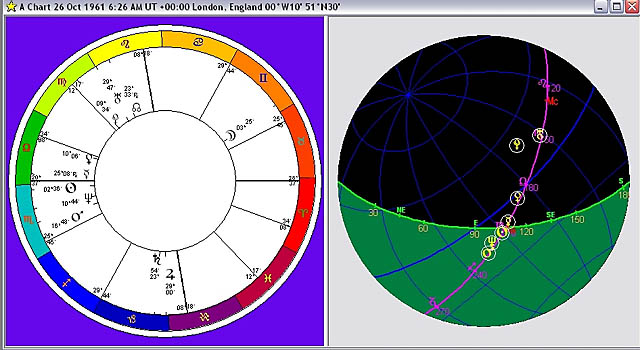
Her sky map (above) for the moment of her birth shows her full moon, low to the horizon and sitting between the stars of Scorpio and the beast of Lupus, the wolf who is being killed by Centaurus, also known to astrologers as the centaur Chiron.
Beasts in mythology are killed because they are feared. So one has to ask: "Fear of what?" The relationship between wolves and people evolved in Ice Age Eurasia [3] about a hundred thousand years ago. Survival threw them together in a way that meant the wolf-human hunting relationship was governed by mutual tolerance and respect. This relationship changed when humans assumed a pastoral and agricultural life-style where growing domesticated animals for food required control and ultimately the elimination of predators such as the wolf. This was embroidered onto the sky as the story of the Centaur killing the predator Lupus. Was this the fault of the wolf or the lack of recognition of what a change of lifestyle implied?
By analogy and application to Duncan, we can hypothesize that she represented a raw wildness in her dancing, dangerous in its implication for change, yet ultimately proving that that which is to be feared brings great blessings. This was unconsciously summed up by photographer Max Eastman who is quoted as saying,
It was never easy to coax Isadora Duncan
into a photographer's studio.
We can gain further understanding by considering one of her lunar parans: Starlight says of Duncan’s Moon culminating when Scheat is risingChallenging social conventions; free-thinking in the arts, cuisine and matters of care Her life as an individual was one that would not be chained to convention. She was constantly defying social taboos. She did not believe in marriage – a huge statement for the early 20th century - and gave birth to two children from two different fathers. Inspired by her as a role model, many schools created the space for dance to become part of the curriculum, beyond exercise, a life-enhancing experience. In conclusion
The full moon moving along the horizon is an awesome sight. Once believed to be drawn down by performance in ancient ceremonies, we can still see its expression in the charts of those who have been born at such an auspicious moment in present time by how they expressed it in their lives. Duncan’s parents named her Dora Angela. Dora is Greek in origin and means “gift”. Duncan brought with her the gift of angels in the way that she danced but perhaps the drawn down moon enhanced this gift and gave her the concrete ability to express it more clearly and succinctly, a true Thessalian witch bridging worlds to inspire and uplift us. ----------------------------- (1) There are two dates for Isadora's birth. The most astrologically accepted is from a recently-recovered baptismal record which states this as being " 26 May 1877", Another cites "27 May, 1878". Interestingly these two birth dates are a year and a day apart, the traditional length of a witches' year. (2) Francois Delsarte (1811-1871), was a student at the Paris Conservatory. Fuelled by a hunger for more “realistic” acting, he began studying how humans actually moved, behaved and responded to a multitude of circumstances recognizing emergent expressive patterns which eventually became the Delsarte System of Expression which flooded into all levels of the culture. http://www.delsarteproject.com/history.htm - accessed 2nd March 2006. [3] From
"Beringia Natural History Notebook Series - September, 1992",
Alaska-Hawaii Regional Office [4] Isadora Duncan Dance Foundation: http://www.isadoraduncan.org/about_isadora.html - accessed 2nd March 2006.
Do Comets have a voice in Visual Astrology?
Thanks to newsletter reader Yururu, from Colombia, who emailed us asking about the relevance of the new comet (Comet Pojmanski) appearing amongst the stars of Sagittarius and Capricorn. There is little that has yet been translated in the Babylonian corpus concerning comets. The only reference I could find was in Hunger (1992:194) and it is the following:
The path of Anu is the path of the ecliptical stars and kingdom of Elam was a kingdom lying to the south -east of Babylon. This type of prediction from the "Chaldeans" - the name given to the astrologers from Babylon by the Greeks - is probably the seed that gave birth to linking comets to negative events, for any random event of the heavens was viewed as a mark of change and change was to be feared.
But let
us take a more post-modern approach to this comet. Given that it is
near Venus and in the stars of Capricorn, are we looking at some type of
event concerning an elder or wise global female figure? This does not have
to be a negative event. However, this question really begs a larger question:
Are comets relevant to visual astrology? I honestly do not know. What we
do know is that we have an opportunity for making observations; we must
also resist the temptation to generalise. ---------------------------------- |
||||
|
Sources: Hunger, Herman. (1992). Astrological Reports to Assyrian
Kings. Helsinki, Finland: Helsinki University Press. 339
| ||||
|
|
For Your
information We only have 20 free rulers left to give away. These rulers are included free of charge with any order for the new Studyshop - The Zodiac: Urban Tribes by Bernadette Brady. This studyshop, with the free ruler, has been most popular so you may wish to explore it. Click here for more information. Special notice receiving this newsletter With new filtering systems monitoring emails many of the people who wish to receive this newsletter are being blocked by internet email filters. Thus in order to ensure that you are able to continue to receive this newsletter, please add our email to you address book: newsletter@Zyntara.com Thank you.
|
|||