|
"What is this love by which
Istar
loves the
king, my lord...."
A bright Venus joins with Saturn
Bernadette Brady M.A.
Around the year 660 BCE the Assyrian priest
Issar-sumu-eres wrote a letter to
his king containing one of the earliest-known associations of
Venus with the idea of love. In this letter he observed the closeness of a
bright Venus to Saturn and wrote:
What is this love by which Istar
loves the
king, my lord, and has [sent] the very best to
the king my lord!
(Hunger:16)
With this letter in mind, then, this month look up and
note what is happening in the sky. Usually only
about once a century we get a bright evening Venus radiating a
powerful Saturn near the great star Regulus – the king star, and
this time is with us again. In
visual astrology such a radiation implies a gift to the king, a gift
to those who are in power, a blessing on the establishment. The
king (Saturn) is already strong as he is sitting with the stars of
Leo, the great regal constellation.
 |
In the last few hundred years we have had
only three occurrences of this sky story. The last two times the
Moon has passed gently underneath this interesting and
regal union of Saturn and Venus.
However,
in this month, for the only time this century and the only time
in the last 170 years, the crescent Moon
will pass in front of Venus, temporarily blocking her from the
evening sky, and then within a few hours the Moon god, Sin, will
continue on his journey and dare to block out the king himself -
Saturn. |
In modern terminology the crescent Moon will be
occulting both Venus and Saturn.
This sky event will occur on the night of the 18/19 June 2007 –
so go outside and look up at the sky and to the west where you will see
Regulus, Saturn, Venus and the crescent Moon.
 |
What
makes this even more interesting is that on 30th June and
therefore within this same lunar month, Venus which is still
bright and radiating, will also occult Saturn.
This symbolises a royal union which is
potentially joyful, fruitful or blessed. Such a union refers to those who are royal or those who hold power.
However, in
this sky story this union is marred or altered by the Moon god's
lack of support. For as he begins his new month, Sin actually
blocks out both planets, suggesting that he is removing,
ending, dissolving or breaking apart this blessed union.
|
|
A blessed union that the Moon
god, Sin, signals is breaking apart. |
I would think that if this combination was seen by a
astrologer/priest from the Mesopotamian
era, there would be warnings sent to the king about his wife or
lover.
In the recent
past
The last time the bright evening star, Venus, joined with
Saturn in the stars of Leo was around the 30th June, 1978 . At that
time the
English Prince Michael married baroness Marie-Christine von Reibnitz.
and gave up his right to the throne because of his wife's Catholic
faith. Venus joined with Saturn in the stars of Leo and the Moon passed
gently and almost approvingly underneath the royal pair of
lovers.
The time before that was in 1919 and the world was
caught up in WWI but as Venus joined with Saturn in the royal star
of Leo, the Moon once again moved underneath the union, showing its
support, and within days of this celestial event the
Treaty of Versailles ending WW I was signed in France on
28th June,
1919. Germany and
its allies were forced to accept full responsibility for causing the
war and, under the terms of articles 231-248, were made to disarm,
make substantial territorial concessions and pay reparations to
certain countries that had formed as Allies.
Prior
to
1919 we have to move back to 1831 when, in late June, a bright
evening star, Venus, joined totally with the King, Saturn, as the
Moon god swept over them both. At this time the joint powers of
Europe granted Belgium (at the London Conference) its
independence from the Netherlands and a new king was created – King
Leopold I of Belgium.
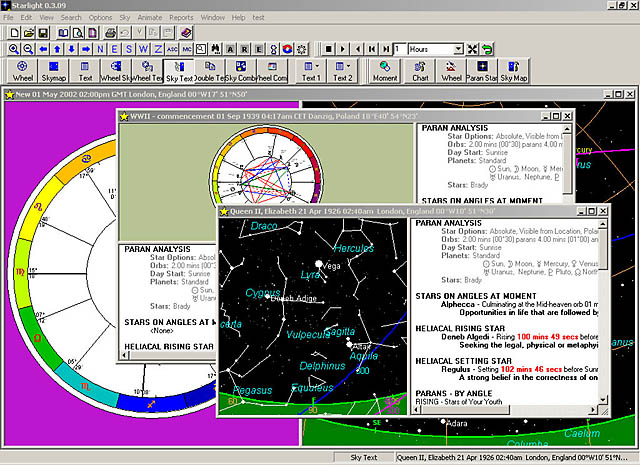
[If you own Starlight, have a look
at the sky for these three dates and compare these skies with the
sky later this month. Also while you are looking at these skies from
the past, animate the screen so you can watch the Moon travel
beneath for the 1978 and 1919 dates and in front of planets for the
1831 date. It will give you an whole new slant on the location of
the Moon!]
|

|
 |

|
|
On 30th
June, 1978, Prince Michael gave up his right to the English
throne to marry the woman he loved. |
The
signing of the Peace Treaty of Versailles on 28th June 1919 -
stripped Germany of power and forced it to pay heavy
reparations. |
King
Leopold I of Belgium, given the throne in July, 1831, by a
joint meeting of European kings at the expense of the
Netherlands. |
Once again, just as in 1831, the sky is producing
the same narrative. A union, if made, will involve a sacrifice or
loss OR maybe a union is to be broken, removed and dissolved. In
recent days there has been news of the G8 meeting reaching an
agreement about climate change. Could this be part of this sky
pattern, or is there a country with a
new independence to be granted or a royal union which will
end? Will a union of heads of states fall out? We are
already seeing tensions in the “friendship” between Blair, Bush and
Russian leader, Putin. One can never predict exactly how this will
manifest but we can see that visual astrology strongly suggests that a union, royal or
between powerful people, is going to end in late June or July. Let us
wait and see. In the meantime see if you can make the time to
go outside and look at this bright Istar that loves the king so
much.
Sources:
Hunger, Herman. (1992). Astrological Reports to Assyrian Kings.
Helsinki, Finland: Helsinki University Press. pg. 16
Starlight Software (2002) Barnswood and
Brady:Zyntara Publications
StarLogos -
There and Back Again
Memories of a conference
Darrelyn Gunzburg
It begins on a train. Carriages with leather purple
seats that can carry eight people apiece, each with pull-down bunks
for overnight travel and their own wash basins; windows that open to
the shifting landscape of vineyards and townships, black arms
clutching hope in their baskets of grapes for sale, and mountains
crushed by time captured gold in the afternoon sun; corridors the
width of a person, making it impossible to pass another; lunch in
brown paper bags that preface the gourmet meals that are to come;
and an hour and a half delay when the train engine breaks down,
ensuring we arrive to a dark sky and the splendour of Scorpio
rising.
A dream that has been conceived over coffee one
morning a year earlier in our kitchen in Bristol, UK, with Nicky
Allsop suddenly has shape and form. Thus it is that this
small wayside town of Matjiesfontein, founded in 1884 by
the British immigrant Douglas Logan, set in the wilds of the Little Karoo,
this place frozen in time, whose main hotel, The Lord Milner, is
still awash with original Victorian furniture, Kipling’s “map that
is half unrolled"[1] becomes home to thirty six astrologers
for five days.
 |
 |
|
The Lord Milner Hotel |
The cold and the open sky |
We have chosen this time of year for specific
reasons: we choose it for a dark moon to better see the sky; we
choose it for its distance away from light pollution; we choose it
to see Scorpio, a rare sight for those not raised with southern
hemisphere eyes; and we choose it for the clear weather.
After a welcome of sherry on the platform at
Matjiesfontein, and a quick dinner with sky maps to orientate us, we
are driven this Friday night in the hay wain of an incredibly
slow-moving tractor into a farm field away from the contaminating
light of the hotel. We encounter a spectacular sky but we have not
reckoned on the wind chill factor. The only solution is to huddle
closely together imitating emperor penguins in the Antarctic as Bernadette, complete with Sky Scout, a
revolutionary handheld device that uses
advanced GPS technology, traces the lines of
stars into a three dimensional reality: Scorpio with its
red-heart Antares and a brilliant Jupiter below it on the ecliptic,
the Centaur kicking its heels around the Southern Cross, the vivid
blue Spica in the wheat sheaf of Virgo, Leo with Regulus and a
bright Venus dropping into the west. Glorious. But sooooo cold. So
cold Bernadette can’t set up the portable PA and we have to split
the group into two viewings. So cold we know exactly what Bernadette
means when she recounts lines written by the
Assyrian astrologer/priest some
several thousand years beforehand:
“It is so cold I can no
longer watch, my king, I must go inside…”
It’s phenomenology we could not have conceived we
were going to experience. We've come so that the the patterns of the stars
can reveal themselves and etch
indelibly into our minds but it is this unseasonable cold which
directly connects us with our Mesopotamian ancestors.
Carrying these patterns, these narratives into the
class room on Saturday morning, the old Court House built in 1897, we begin with a debrief. How
has seeing the sky changed or affected us? What dreams have we had
after meeting the sky of the previous night?
What insights have we gained? Building on this night sky viewing, Bernadette walks
us through ways of seeing charts through Mesopotamian eyes: the
love, passion and rage of Ishtar (Venus) and Nergal (Mars), the
constant power struggle between the King (Saturn) and The Crown
Prince (Jupiter), and Nabu the Scribe (Mercury), the Messenger or
Thief. We consider the eighteen stars of the way of Anu, that
ecliptical area between Ea (earth) and Enlil (sky), some of which,
in focusing on our modern tropical zodiac, we have lost, such as the
strange-named Anunitum and the Great Swallow.
 |

|
|
Inside the Old Court House
|
Duccio di
Buoninsegna's Triptych (1300-05)
|
In the afternoon is the first practical session. We work with
students’ charts in class, offering observations and seeking
empirical evidence from them of how the orientation of their planets
in their charts across the twenty-four hour period of sunrise to
sunrise that encompasses their birth time makes sense for them: is
Nergal about to descend into the Underworld? Do they have a Sulpae
Jupiter, returning to the sky ahead of the Sun or is it Niburu and
hence extinguished by the Sun as it culminates? and so on.
New material takes time to process and Bernadette and
I deliberately plan sessions after afternoon tea that are “lean
back” and receptive, not “lean forward” and focused. This first
“lean back” session we name “The Sky Revered” and I shape it as a
visual journey that examines the cultural implications of how we
interpret the fixed stars and make sense of them in our art through
tombs, temples and cathedral domes; and then reflect on how the
constellation Virgo has slid into medieval Italian religious altarpieces through the cult of the Madonna and the Woman of the
Apocalypse, refracts into Protestant England through Queen Elizabeth
I and unconsciously proliferates into current time through the life
of Diana, Princess of Wales.
Happy Hour spills into dinner and then into the
"Laird's Arms" pub with its massive mirrored bar and counter and
1902 cash register. Initially this building was used as a
carpenter's shop by two Scottish carpenters brought out by Logan
from Scotland to do all the joinery in the village. Later it became
a butcher's shop. During World War II it was turned into a
recreation room for Royal Navy sailors on leave from Simon's Town.
After the War, it served as the Village Hall. This night the bar
takes agency. Lying across the far end of its polished wood are a
family of 1920s hats: a broad brimmed hat tilted at a jaunty angle
with a flirtatious quality and attached black curls turns Nedret Saidova into a Young Sophisticate; a cream wool cloche turns Eve
Sibley into a Flapper; a woollen cap with dreadlocks turns Michael
Darlington into an Old Salt; a hat with a lavish brim swathed in
tulle turns John Wadsworth into a Happy Widow. Every time I see Sue
Farebrother she has morphed into another personality under a
different hat. Behind the anonymity of such headwear, a spontaneous
craic
emerges: dancing, singing and much laughter, culminating in
Marcia Butchart’s sinuous, mesmerising belly-dance across the pub
bar. A fitting evening for skies that are now covered with cloud and
raining.
Sunday morning. With optimistic planning and anticipation of clear
weather, it’s now raining heavily. Back in Cape Town the weather
prediction had been for “tons of rain” and it has taken little time
to sweep east upon us. Once more the day begins with a debrief,
followed by Bernadette walking us through Babylonian Star Phases -
the Heliacal Rising and Setting Stars - and understanding how stars
work in paran with planets. A good lecture for Sunday morning as
Bernadette shows how the star phases weave into the current theology
of souls, saints and enchanted places.
After lunch the second practical session
threads Mesopotamian planetary interpretations and visual sky maps
with Babylonian Star Phases and parans. We’ve alerted everyone at
the beginning of the conference that the third practical session on
Monday afternoon will consist of them reading a fellow delegate’s sky map
and chart in this way, so there is focus and attention on how to
pull these concepts together.
Afternoon tea is followed by a “lean
back” lecture from Bernadette entitled “To Touch the Moon”, a
glorious look at Sin (The Moon), the god that empowered the king;
the drawing down of the moon in its annual cycle where
full moons of the summer months,
regardless of hemisphere, are lower in the night sky, keeping closer
to the horizon, than the full moons of the winter months which reach
a greater elevation in the night sky. (Interestingly this
gives rise to the concept of being born with a drawn down Moon and
Bernadette shows us that Neil
Armstrong is born with such a Moon); and the meaning of lunar
eclipses which set with “unwashed feet”, for lunar eclipses are key
events in the Mesopotamian view of the world.
At dinner we hold an auction to raise “thank you”
tips for the sweet-natured staff of Matjiesfontein hotel and the
catering firm, ClockHeart Catering, based in Cape Town, whose every
meal has been a epicurean delight, including star-shaped cookies
for afternoon tea. John Martin has accompanied his wife, Clare
Martin, current head of the Faculty of Astrological Studies, to this
conference as a non-astrologer, yet his wit as auctioneer adds a
unique spin to the evening as he encourages people to bid for a
see-through plastic inflatable globe with
star constellations “worth nothing on the market, yet how much will
someone offer?” Monika Gindl-Muzik wins the bidding war and takes it
back to
Vienna with her. We’ve also donated one of only two
copies of our full colour wire-bound books containing all the Visual
Astrology Newsletters to date. It’s a fast bid going to Chrissy
Phelp.
After dinner the sky clears. Our sound man, Gary
Cousins, offers to guide people again through the sky, this time
near the hotel, so we can continue to relax and Bernadette can rest
her voice which has turned into a croak. We think it is a ploy
to get his hands on the Sky Scout but it is also an important
opportunity for people to revisit the sky, refind the star patterns
and consolidate what has been learnt on the first night.
By the time we wake on Monday morning the complete annual rainfall
for Matjiesfontein has fallen in just four hours, filling the dry dusty creek bed and
turning it into a torrent of ochre. We dare to believe this is a
blessing from the heavens. It is now so cold that the air is
interleaved with thin flakes of snow. We are all wearing every piece
of clothing we have brought with us.
 |
 |
|
A running river in the desert |
Doing Visual Astrology |
Monday’s teaching day begins once more with a debrief of insights
and dreams, followed by Bernadette presenting her techniques of how
to look at modern mundane astrology through Mesopotamian eyes. After
morning tea Nicky Allsop presents her work on fertility using the fixed
stars.
It is in the afternoon session, when delegates work on each other’s
charts, putting into practice their visual astrology muscles, that
the conference work truly comes into its own. No amount of theory
can replace practical insights, and the sense of joy and empowerment
from people in the feedback session after afternoon tea awes us
both.
Tuesday morning ironically dawns bright and clear
and, again ironically, in the end is our beginning. After all the
hard work we have done in preparation, we knew that those attending the
conference would be encountering a whole new phenomenon of the sky
and how to read it, and thus we have been open to re-arranging
lectures on the fly. So it is that Bernadette's very first
lecture, “The Missing Sky”, is given as the final lecture, a wrap up observing
how the great vault of heaven has morphed in modern times into
the sterility of “Mars Bars”, “Mercury” outboard motors and the
stylised Virgo as the insignia for Starbucks coffee, to name but a
few instances.
Then it’s time for final packing and boarding the
bus, taking us away from Matjiesfontein, back into Cape Town and
final goodbyes.
So why did we go to Matjiesfontein and what did we
learn?
We are drawn to astrology because we love the stars, yet the
modern world is full of astrologers who have become disconnected
from the sky. We dare to laugh at those whom we say live in
“flatland” yet we live in flat charts, separated from our tool of
trade, the patterns in the moving sky. This journey was a big ask,
for we know what it takes to stand in a different perspective. It
was gratifying that the conference drew astrologers from across the
world but more so that that those who came dared to walk with us
across that divide and saw for themselves the breath-taking sky
through Mesopotamian eyes.
Thank you all who joined us on this part of the
journey. You inspire us to continue and may your own work unfold
with insights.
[1]Kipling, Rudyard. (1894) The Native Born in “The
Seven Seas”, Methuen:London.
|