|
|
|
When beggars die, there are no comets
seen,
The Heavens themselves blaze forth the death of
Princes.
(William Shakespeare, Julius Caesar)
Bernadette Brady
M.A.
Traditionally
comets in astrology have been linked to disasters or the death of
kings but this is a concept that is worth unpacking.
There
seem to be only a few references to comets found in the translations
from the Mesopotamian astrologer priests to their kings. This is not
what one would expect, as comets are reasonably frequent.
Indeed since the year 1800, a period
considered to be quiet for comets, we have had over forty bright
comets slashing through the starry sky. So either the Mesopotamian
astrologers were not concerned by these “hairy stars” (the Greek
word is Kometes which means hairy) or those particular
letters have simply not yet been translated
or found. However, Herman Hunger gives us one letter from the
Babylonian priest Asaredu the Younger written around 671
BCE. Asaredu was referring to a comet which became visible at the time when Jupiter
made its last appearance in the night sky
and he wrote:
[If] a comet [becomes visible in
the path of the stars of] Anu: [fall of
Elam. Its] people [......]
will be confused [......] city with city [......] brother
will kill brother [......I the king of Elam [......]
his days are near (to their end). [1]
Asaredu’s
letter shows us that by the 7th century BCE comets were
already harbingers of woes and troubles and considered heralds of
the death of a king.
This view was highlighted
when a comet appeared in 44 BCE after the death of Julius Caesar and
then reinforced in 79 CE when a comet appeared and was considered to
be a warning of the death of the Emperor Vesparian who dismissed the omen as he was bald: “This hairy star does not concern me; it menaces
the King of the Parthians for he is hairy and I am
bald” [2]. Vesparian did, however,
die later in that year. Indeed people’s belief in linking
comets to the death of kings was so strong that many were surprised
when no comet appeared in 814 after the death of Charlemagne.
But, as I have indicated, comets are
not that rare and since 1950 we have had at least twelve comets all
visible to the naked eye. The following is the list of bright comets
in the recent past.
|
Visible
comets since 1950 |
Period of visibility |
| 2002 Ikeya-Zhang |
Visible to the
unaided eye in March and April - cut between Venus and
Mars. |
|
1996
Hyakutake |
Observed
with the unaided eye from early March
until early June. |
|
1995
Hale-Bopp |
Visible with
the unaided eye from July 1996 to October 1997. |
|
1975
West |
Followed
with the naked eye from late February
until mid-April. |
|
1973
Kohoutek |
Period of
naked-eye visibility spanned the end of November until late January. |
|
1970
White-Ortiz-Bolelli |
Seen
visually only from the 18th May until the first week of
June. |
|
1969
Bennett |
Under
observation with the naked eye from February
until mid-May. |
|
1965 Ikeya-Seki
|
Observable
with the unaided eye from early October until mid-November - The most brilliant comet
of the 20th Century. |
|
1962
Seki-Lines |
A naked-eye
object from late February through to
the end of April. |
|
1961 Wilson – Hubbard
|
Visible to
the unaided eye only between 23rd July
and the first days of August. |
|
1957
Mrkos |
Followed
with the unaided eye from 29th July
until the end of September. |
|
1956
Arend-Roland |
Naked-eye
visibility extended from mid-March until
mid-May. |
So given that the above twelve
comets have not all been associated with the death of kings, we can probably place little store in this
ancient thinking. However, this is not the
end of the argument.
It has been a long time since we
have had a comet which passed seriously close to the earth. Irish scholars McCafferty and Baille [3], basing their findings
on dendrochronology (dating climate change
via tree rings) and mythology, argue that
the earth has experienced close comets and that some of these close
comets were recorded in Irish mythology. They put forward a strong
argument that the god Lugh, (whose name means light) - iIn Welsh mythology he
is known as Llew, and in English mythology he is
King Lear - was just such a
comet.
  |
In the early version of the
mythology, Lugh is described as being
as bright as the sun but not the sun. This theme of "being the sun but not the sun" is also expressed in a question in the
early myths put to a Druid priest by the Irish warrior Bress who stated:
"It would seem wonderful to me that the sun should rise
in the west today and in the east every other day", said Bress to his Druids. “It would be
better for us if it were so” replied the Druids, “It is the
radiance of Lugh of the Long Arm”. [4]
|
|
Two version of Lugh: Left a flaming
sword and right, a more ancient image showing his solar disk.
|
|
|
McCafferty and
Baille point out that a close comet can rise in the west and
be as bright as the sun but would, unlike the sun, have a long
arm or column. They also revisit the descriptions of mythic
heroes who are full of light and fire and put forward a
convincing argument linking comets in history to the
description and stories of great Celtic solar
heroes. Such heroes include the Irish warrior Cuchulainn
as well as the legendary King Arthur and his flaming sword.
Cuchulainn is linked to a comet because of his rage, flowing
hair, and brightness which outshone the sun while Arthur is inked by his sword which shot flames up
into the sky like a column of light, similar to
Lugh. |
 |
| |
Cuchulainn with his brooch brighter than
the sun (John Duncan 1913) |
We also have additional
evidence, apart from mythology and tree
rings, of such close encounters. In 2350
BCE, Chinese astronomers recorded a time when ten suns were in the
sky, all shining brightly. Later in 174 BCE, Titus
Livius tells us that three suns shone all at once with
burning torches falling to earth; and then
in 42 BCE Diodorus of Sicily reported the sun shining at night. All
of these three historical reports are suggestive of comets passing
close to earth.
 |
A close comet may look like this image but with far
more light and possibly flaming,
falling debris. |
This theme of close comets
generating stories of gods is also reflected in the writings of
Pliny the Elder (79 CE) . When he described
eleven different types of comets based on their visual appearance,
he conveyed one of these as:
A white comet with silver
hair so brilliant that it could not be looked at and having the
aspect of a Deity in human form.
Indeed in considering the image
above (my simple attempt at reproducing a close comet), it is easy to accept that such a comet is, firstly, quite destructive and,
secondly, could be seen as a deity.
 |
Comets
also come in many different shapes,
not just the pencil like shape we see in images and drawings.
In 200 BCE the Chinese constructed a comet atlas which was
recorded on silk.
This atlas shows
shapes of comets varying from a swastika to shields to trees.
|
| The Mawangdui, Changsha, silk comet
atlas 200 BCE |
|
So I think that it is important as
visual astrologers to recognize that not all comets are the same and
it may well be that the messengers of doom and gloom (the
traditional role of comets) can probably be
more successfully associated with close
comets that shower the earth with debris and/or seriously impact on
climate, causing destruction or, at the very least, providing such a terrifying
display of heat and light that the fabric of society is damaged.
But the comet of January 2007 (Comet McNaught), although now officially award
the title of “Great”, in fact was distant
and tame and has now left us for some hundreds or thousands of
years. Such a comet is unlikely to herald the death of a king or
other such disasters. Yet as astrologers we instinctive seek meaning
in our ensouled sky.
So what can visual astrology tell us about this latest
comet?
It so happened that comet McNaught
cut across the ecliptic at the very time that Mercury was making a
reappearance in the early evening sky and in
doing so, the comet was seen to split the
path between Mercury to Venus, breaking the normal link between the
two sky figures. On one side was Venus radiating the stars of
Capricorn, which are symbolic of that great civilizing domesticating
god of Ea who brings order to his people. On the other side is
Mercury, a messenger seemingly returning
from the underworld (see image below).
|
 |
|
Comet McNaught
passing between a bright Venus and a newly-emerging
Mercury |
In 2002 comet Ikeya-Zhang appeared to pass between a Venus
amongst the stars of Pisces, newly emerging
in the evening light, and a bright Mars, low
in the west and within the stars of the constellation Aries
(Starlight users may wish to have a look at the western horizon of a
sky map for 18th March, 2002). The events of
the year 2002 were filled with the drums of war as President Bush
talked of the Axis of Evil. It seemed as if the calming ability of
Venus was totally cut off from the heat of Mars who was sitting
above her in the sky.
Now with comet McNaught we have the
calming influence of a bright Venus in the civilizing stars of
Capricorn being cut off from a messenger coming from the war-like
stars of the constellation Sagittarius. Venus is higher in the sky,
so one tends to think that this year will be remembered as one where
there were further provocative acts but finally cool heads
prevailed. Maybe, just maybe, this comet is
indicating that governments, in all parts of the world, will not be
so quick to respond to calls for vengeance or aggression.
I think this comet is a harbinger of
good news, finally breaking the link between the warrior stars of
Sagittarius and the government/ruling-class/establishment stars of
Capricorn with the calming effect of Capricorn or Ea prevailing.
____________________________
1.
Hunger, Herman. (1992). Astrological Reports to Assyrian
Kings. Helsinki, Finland: Helsinki University Press.
pg.194. 2. Sagan C. and Druyan,
A. (1985) Comet. Michael Joseph, London: pg 25 3.
McCafferty and P. Baille, M. (2005) The
Celtic Gods, Comets in Irish Mythology. Tempus. London 4.
Squire, C. (1912). Celtic
Myth and Legend: poetry and romance. The Gresham Publishing
Company. London. pg 111 |
Facies, the pain of
arrows A
Case Study -
Darrelyn Gunzburg
In previous issues of the Visual
Astrology Newsletter I have been looking at charts which have planets or
luminaries in paran with what are traditionally considered to be be
"difficult" stars - Zosma and Algol. In this issue I want to continue
exploring this group of challenging stars with a case study involving
Facies.
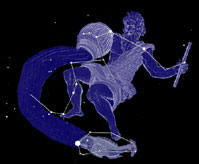
Facies is the star in the head
of Sagittarius the Archer. The earliest writings about this Archer are on
cuneiform tablets from the Euphrates calling Sagittarius the Strong One or
The Giant King of War [1]. The Egyptians saw it as
a hand holding an arrow and Aratus called it the Wielder of the Bow. To
the Persians this constellation was Kaman, to the Turks it was Yai, and in
Syria it was Kertko, all names signifying a Bow or Bow and Arrow.
However it was translated in
these various cultures, one quality was constant - to be of worth, the
Archer had to find his target with this bow, otherwise he was of little
significance.
 |
So the Archer
became known as a feared and powerful warrior, able to fight from
afar rather than face-to-face with a sword. Picked for his sharp
eyesight and steadiness of stance and strength, he was the 'green
beret' of the squad when archers were the most important and
powerful pieces in the game of war. Thus the soldier of Sagittarius
was cruel, stormy, wild and feared, an extremely threatening figure
whose greatest skill was his eyesight,
embodied by Facies, the penetrating stare of the one who
holds the lethal weapon, the one whose remit is to force a way
without regard for others. As a consequence, Facies became known as
being cruel and ruthless and its darkest shadow was the evil of war.
Its mantle is that it is considered to be one of the most difficult
and possibly most violent bodies in the heavens.
|
Yet whilst Facies may mean a
person may be non-diplomatic, if balanced, they will also be one who
achieves. For when Facies makes a paran to a planet or luminary in a
person’s chart, the planet it touches will be extremely focused and driven
and the person can push forward with their goals and aim high – as long as
they are also aware that such actions can slide into ruthlessness, for
Facies can as easily express itself as the leader as the dictator. Yet if
Facies is the only difficult star in the person’s chart, then it will talk
more of concentration, than cruelty; if other difficult stars are also
present, then issues of heartlessness and even brutality could be a
problem.
The
other side of Facies is the individual who may be the victim of the
archer's stare. John Lennon, for example, has Facies as one of the stars
on his angles. Brady in Starlight, says of this
combination:
The soldier, athlete, or the aggressor; or alternatively, the
wounded
Lennon was the victim
of a fan’s bullet when he was murdered in
New York City on 8 December, 1980, when he and his wife, Yoko Ono, returned
home after a recording session.
But what happens when you are not famous or in the
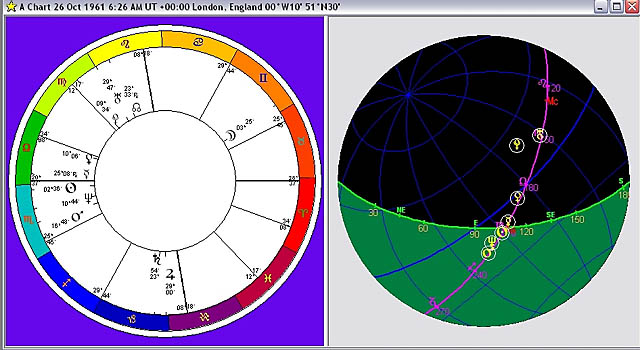
public eye? My client has her Venus-Mars conjunction in Capricorn in paran
with Facies in the prime of her life:
Facies
with
Mars:
[from
Starlight] Endurance, physical or mental, for good or for evil
Facies with
Venus:
[from
Starlight] Anger at
injustices, seeking a different order
Although in the 8th house, this conjunction is within 5
degrees of the ninth house cusp and in the same sign as it, so one can
read this conjunction as taking on more of a ninth house expression. This
exalted Mars in Capricorn with its intuitive base (ruling the 12th house)
and working best with the support of partnerships or business
relationships (ruling the 7th house), uses its practical drive and action
in order to gain outcomes and achievements. A planet in exaltation can be
highly successful, as long as the person is prepared to put in continual
effort and energy and not sit back on one's laurels. Facies in paran with
this Mars, adds turbo power to its hard-working capacity. Mars in
conjunction with Venus makes this a highly creative combination, receptive
(Venus) as well as driven (Mars). Thus my client was not only seen as
steady and reliable (Venus ruling a Taurus Ascendant) and extremely
hard-working (Venus ruling the 6th) in her networking (Venus) but Facies
in paran with her Venus gave my client the right amount of anger at the
injustices she saw to use her networking skills to create a climate of
change.
 |
Has my client use Facies
well? Graduating with a law degree, by her early forties my client
had risen to a position of executive advisor with the Family Court
of Australia (Venus-Mars in 9th in Capricorn).
It was her
vision and that of a colleague which in 2004 led to registries in
the state of Victoria being able to share information and resources,
hence to be more effective for their clients. Here we can see Facies
with Venus in operation: my client recognized a weakness in the
system that disadvantaged family law clients and with endless hard
work and endurance (Facies in paran with Mars in Capricorn), set
about changing the system (Facies in paran with Venus in Capricorn).
|
The success of this venture led to her
work on the joint initiative between the Family Court of Australia and the
Federal Magistrates Court of Australia, both independent courts
established within the Commonwealth of Australia, in developing a new
approach to the way services were delivered to clients in family law
across Australia.
My client was recognized by her peers and the legal
profession as having extraordinary qualities in legal management and the
energy and vision to bring nationwide changes in service delivery to those
in need. As long as my client had visions she could implement to help
bring about change (Facies with Venues) and on which she could work long
and hard with practical results (Facies in paran with Mars in Capricorn),
this "difficult" star was happy.
My client's story does not have a happy ending,
however. In July 2005 my client was diagnosed with
brain cancer and died two months
later.
Despite her sustained focus, my client had encountered the penetration of Facies. We could surmise that with
Facies in paran with Mars, the arrow's work was swift. Yet it is also
important to remember that it is illogical to connect one difficult star
with certain death. Other things were going on in her chart.
My client has since been honoured by the Family Court
of Australia with an annual Award in her name, given to people who
demonstrate the qualities she exhibited: innovation, pro-activity and
providing exemplary service in response to community needs. Facies in
paran with her Venus-Mars continues to drum her qualities of
physical and mental endurance for the good of others (Facies in
paran with Mars) and the ability to seek a better order (Facies in paran
with Venus).
[1] Brady, Bernadette. (1998). Brady’s Book of
Fixed Stars. Maine, USA:Samuel Weiser,
pp.293-299.
Notices:
STAR MONTH
Everything you ever needed to know about adding stars to
your natal charts. This package
consist of three Studyshops:
* The Complete Astrolabe Kit - learn how the sky moves, and
how to find stars.
* Fixed Stars Vol 1 - Sky mythology and
working with star phases.
* Fixed Stars Vol II - NEW - Charts and Stars, a humanistic approach to
working with stars in a natal
chart.
The
complete sky and star package is normally valued at £77.85 but is on
special for £59.95.
AND just for
this month we will email you a FREE fixed star report for your the natal
chart (normally valued at £10.00) and average length 15
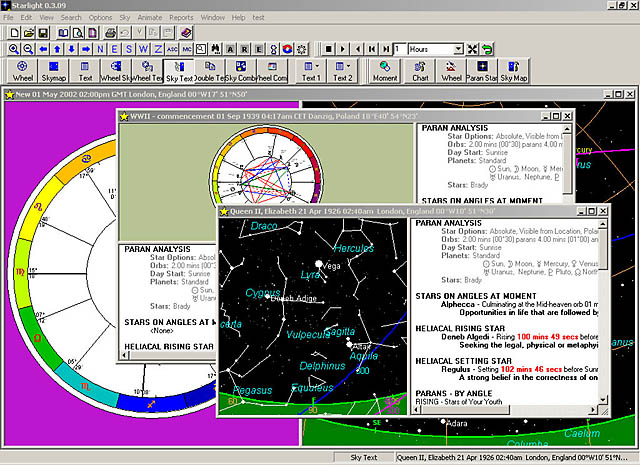
to 16 pages (image above).
Receiving this
newsletter:
Some readers complain that they do not
receive the newsletter but with new filtering systems monitoring emails,
some of the people who wish to receive this newsletter are being blocked
by internet email filters. Thus in order to ensure that you are able to
continue to receive this newsletter, please add our email to your address
book: newsletter@Zyntara.com
Thank you. |
|